 Baganihan Reports
Why traditional master planning will fail without resiliency security
A case for designing land, infrastructure and community as one system, rather than defending an asset from the region around it.
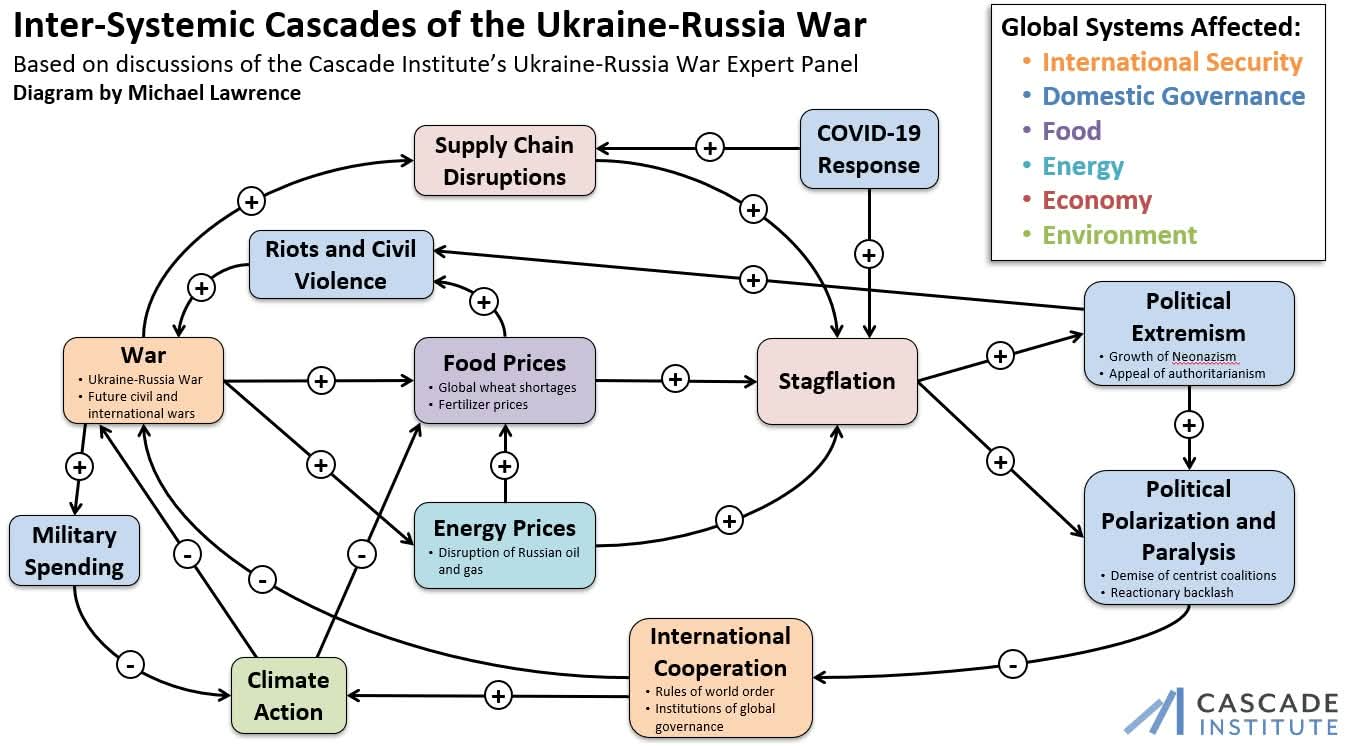
For decades, planners treated the 1972 MIT study Limits to Growth as a distant academic exercise. Its scenarios projected that industrial expansion, resource depletion and ecological overshoot would converge on a structural tipping point somewhere in the first half of this century. My own reading is that we are standing on that horizon now. What global institutions comfortably label the polycrisis, the compounding convergence of climate disruption, supply chain fracture and economic decay, I read as the visible deceleration of industrial civilisation.
Why the Philippines is exposed
In the Philippines, the way we manage properties, corporate estates and rural land developments leaves us dangerously exposed. Our major territorial assets were engineered for a background climate and a global economy that behaved predictably. Neither assumption holds the way it used to.
As a risk management practitioner who spent years conducting physical security audits for mission-critical sectors through Independent Insight Inc., I look at our national developmental footprint and see the same weaknesses repeating across very different sites.
Three structural vulnerabilities
-
Centralised supply dependency
Our commercial and residential hubs remain structurally brittle. Large-scale properties lean heavily on international logistics and highly centralised networks for basic operational stability, hardware and specialised resources. The Philippines is among the largest rice importers in the world and buys most of its fertiliser from abroad. In a sustained economic contraction, those long lines are the first thing to thin out.
-
Catchment collapse
Baseline engineering models here are badly out of date. Mass land developers still clear topsoil and pave over natural topography, which disrupts local hydrology. When an unusually heavy monsoon or a severe typhoon arrives, cleared sites produce severe soil erosion, flash flooding onto adjacent properties and, in the worst cases, foundation failure. Of everything in this essay, this is the most measurable and the easiest to verify on the ground.
-
Geographic position
The Philippines sits at the centre of escalating superpower friction in the Asia-Pacific. Our maritime borders, shipping lanes and communication networks are exposed to external pressure. In a regional conflict, a centralised and highly visible territorial asset is a straightforward target for digital sabotage, local resource competition or simple supply interruption. I cannot tell you that such a conflict is coming. I can tell you the exposure is real and currently unplanned for.
The fatal flaw of hard isolation
When property managers meet a heightened threat, the industrial-era reflex is asset hardening. Higher seawalls, heavier surveillance, taller fences, all of it meant to isolate a valuable asset from the geography and the population around it.
In a compounding crisis, a hard fence is a point of brittleness rather than strength. A development operating as an island of resources inside an unravelling regional economy becomes a target for resource competition and community friction. Concrete walls cannot repair a broken watershed, and they cannot hold together an unravelling local social fabric. If the community outside your boundary reads your asset as an environmental liability or a corporate invader, your physical security model has already failed.
A walled compound inside a struggling region still drinks the same water and still stands on the same slope.
Resiliency security
I would retire the passive vocabulary of sustainability. You cannot sustain a system that is already under strain, and the word has been worn smooth by overuse. What I am arguing for instead is resiliency security through decentralised preparation.
Resiliency security means using ecological design and landscape biology as a form of territorial defence. Through the lens of industrial permaculture, the landscape is not real estate to be conquered. It is a living, productive system designed to catch and slow energy, water and risk.
Rather than clearing land, design multi-tiered biological shields. Targeted earthworks, micro-swales and deep-rooted native vegetation anchor vulnerable topsoil, hold back off-site flash flooding and reduce ambient temperatures around infrastructure. These are established landscape-hydrology techniques, most effective when they are designed to the site. Applied early, they cost far less than fighting the same water later.
Scientific Bayanihan
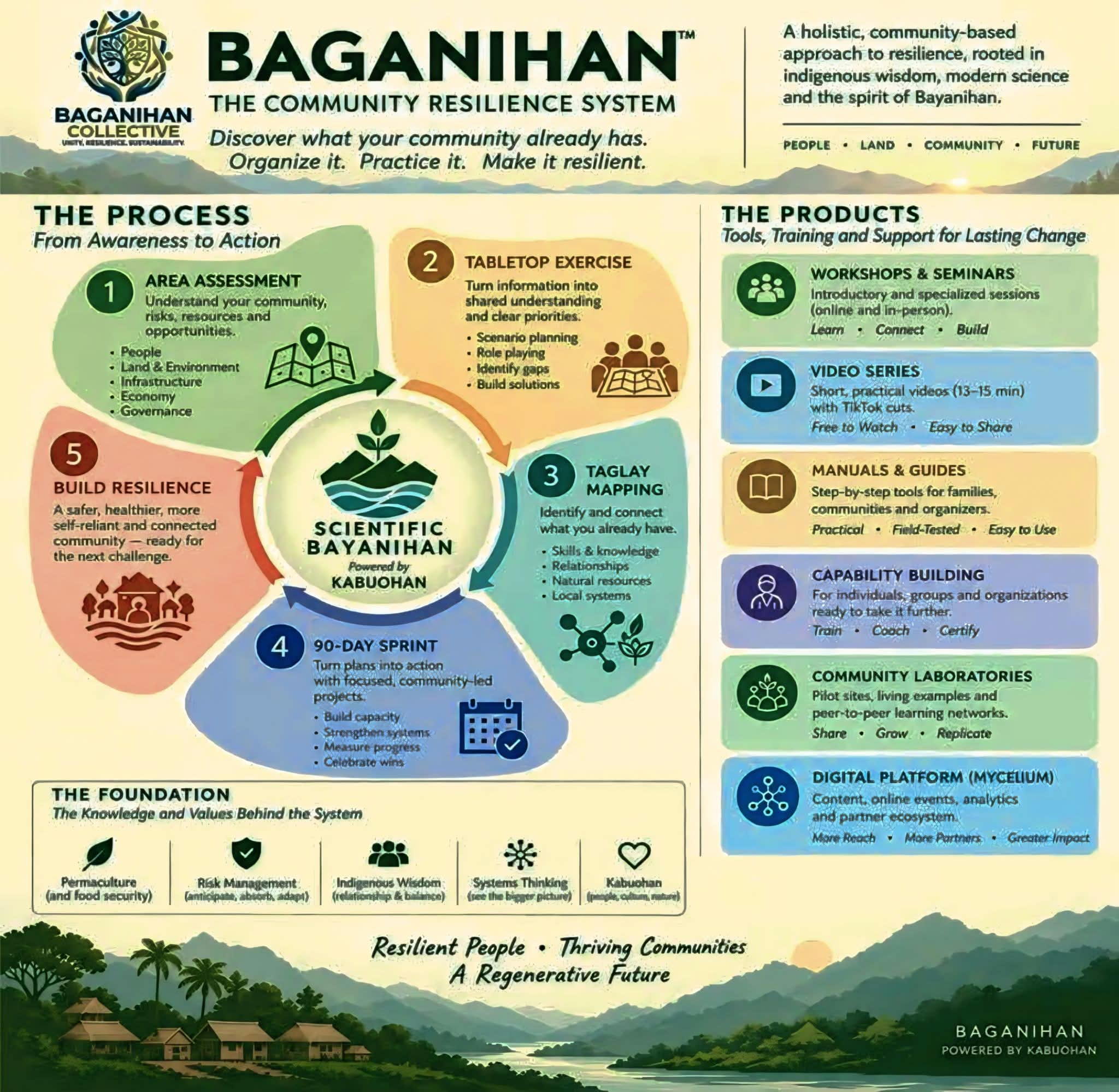
Biology alone is not enough. The social matrix has to be engineered too, and this is where the Baganihan Collective works.
As an initial phase of preparing for compounding risk, we focus on engaging communities to establish decentralised networks of regional resilience. We do that through Scientific Bayanihan, which takes a sentimental cultural ideal and turns it into a rigorous social method. Through that framework we organise human resources and community capability so they integrate directly with the territorial layout.
By designing decentralised, productive dual-use agricultural buffers, where local farming cooperatives and indigenous knowledge holders cultivate shade-tolerant crop guilds within or alongside property boundaries, a spatial liability becomes a self-contained, shock-absorbing ecosystem.
When a community's food security, water access and livelihood are stitched into the structural survival of a territorial asset, that community becomes the most effective security arrangement available to it.
What I am asking planners to do
We can no longer afford to design developments that merely occupy land. Master planning has to make the land, the infrastructure and the surrounding community capable of absorbing shock together.
The choice, as I see it, is between building higher fences and waiting for them to be tested, or lowering them and integrating the asset into a decentralised network of territorial resilience.
The field protocols of Deep Spatial Diagnosis, and how hydrological architecture is applied to high-stakes assets.